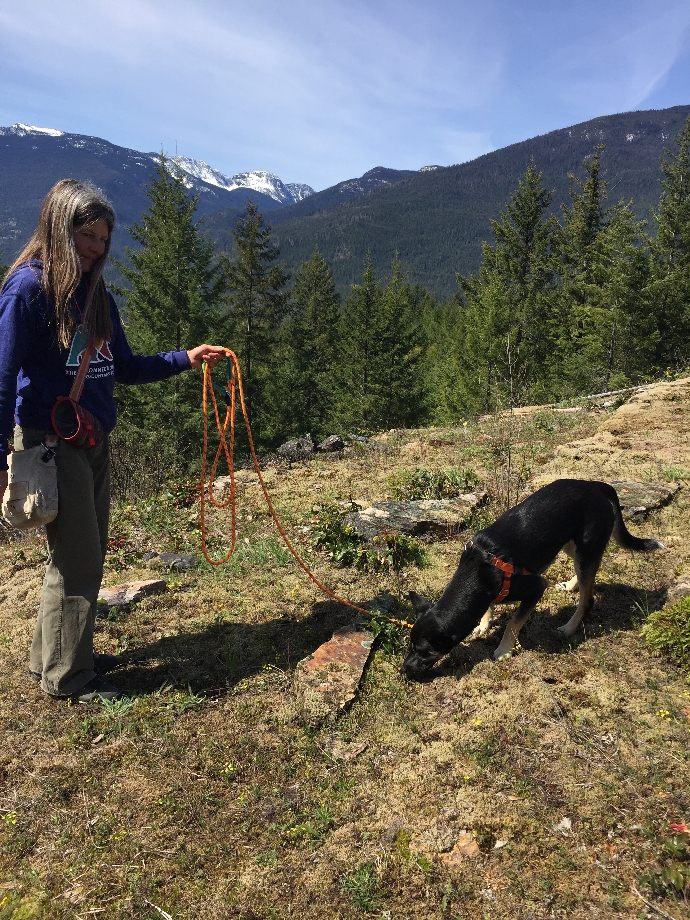
Grow your dog’s off-leash freedom using a long line - Part 2
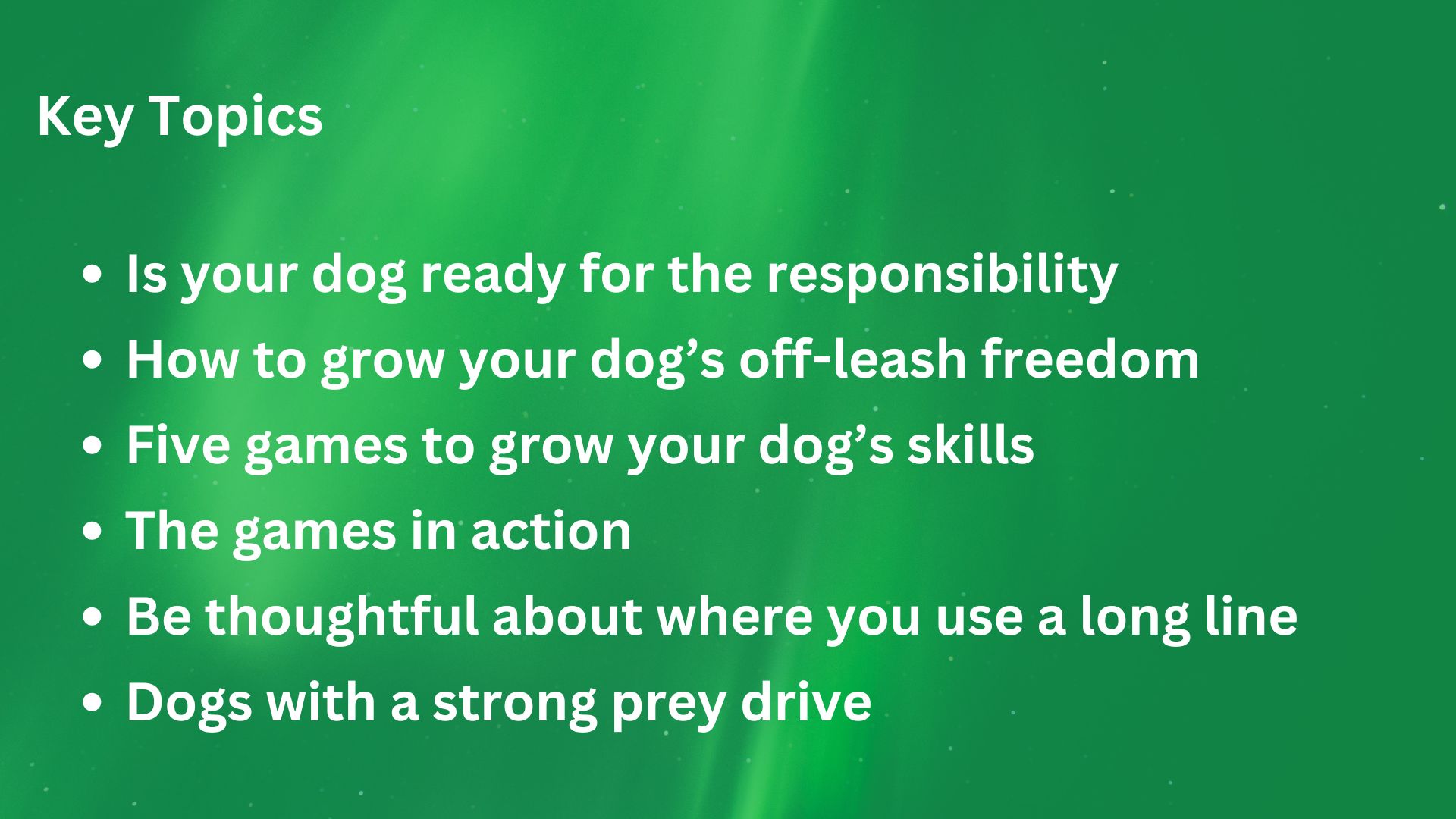
Key Topics
Is your dog ready for the responsibility?
How to grow your dog’s off-leash freedom
Five games to grow your dog’s skills
The games in action
Be thoughtful about where you use a long line
Dogs with a strong prey drive
Last month, I talked about the why, what, how, and when of using a long line to grow the skills your dog needs to be safely off-leash on your outdoor adventures.
This month we will talk about using a long line to grow your dog’s skills so that you can give your dog off-leash freedom knowing that they will stay close and engaged with you.
Is Your Dog Ready for the Responsibility?
Are you giving your dog off-leash freedom even though their brain isn’t equipped to make good choices? Off-leash does your dog:
Chase squirrels, cyclists, vehicles
Ignore you when you give your recall cue
Wander away from you and rarely check in
If yes, they are making good dog choices but not the choices they need to make in the busy and often crowded world they share with us.
For a human parallel, think about a family giving their 16-year-old the keys to the Ferrari. The 16-year-old might know how to drive but doesn’t have the skills or the experience to handle driving the Ferrari in a wide variety of situations including busy freeways or tight city corners.
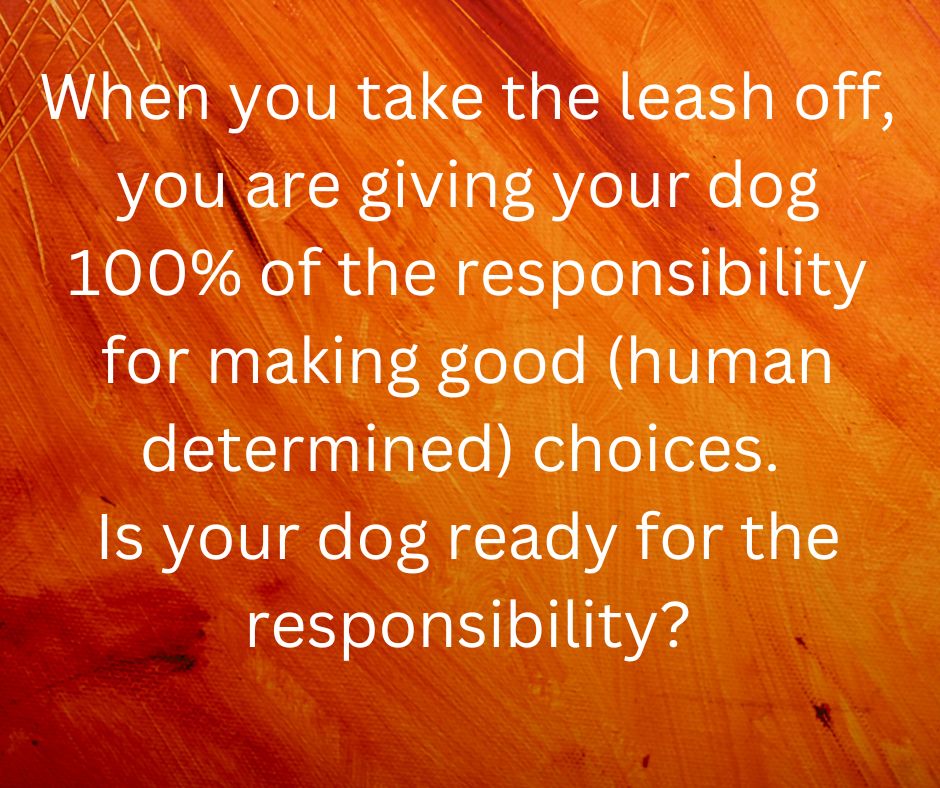
Your teenage dog is like that 16-year-old. When you take the leash off, you are giving your dog 100% of the responsibility for making good (human determined) choices. Is your dog ready for the responsibility?
Without the skills of:
Disengagement (from the environment),
Proximity (to you), and
Focus (on you)
your dog will make great dog choices but not the choices that will allow them to thrive as a well-mannered dog when outside around other people, other dogs, and wildlife. Your dog needs to grow these skills before they will be ready for off-leash freedom.
How to Grow Your Dog’s Off-Leash Freedom
Growing your dog’s off-leash freedom is about growing skills in a controlled manner while gradually increasing the amount of responsibility you give to your dog.
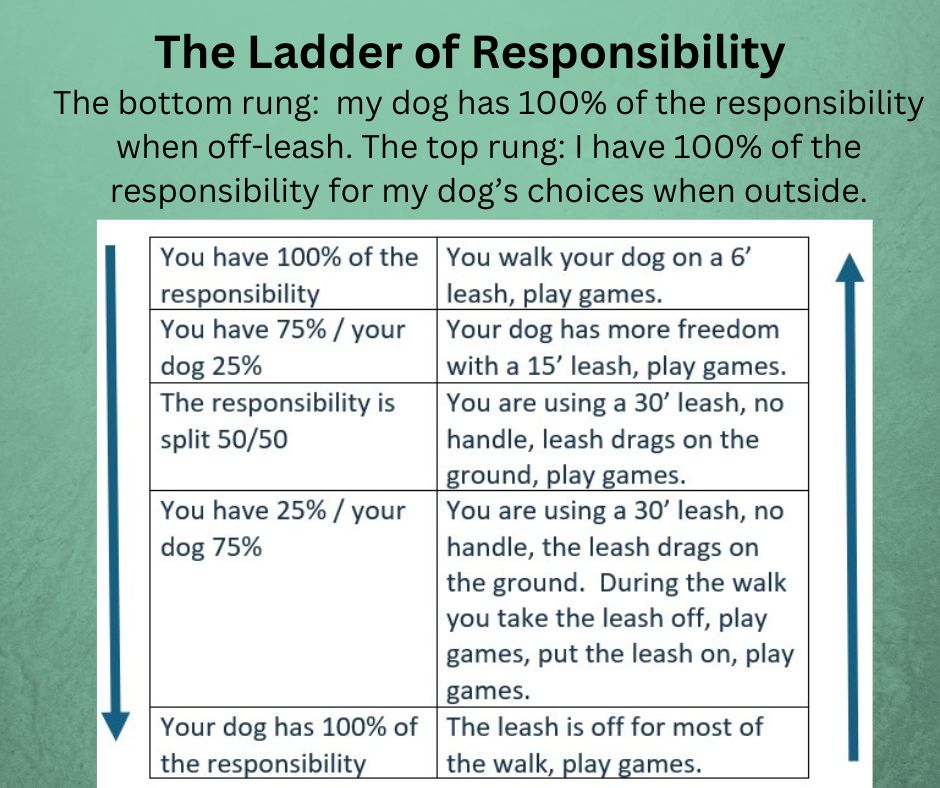
Think about this progression as a ladder of responsibility. At the bottom rung your dog has 100% of the responsibility for making good choices when off-leash. The top rung is you taking 100% of the responsibility to ensure your dog is making the right choices in the environment.
A long line can help you transition from the top rung where you are taking 100% of the responsibility to the bottom rung where you can trust your dog to make good choices when they have 100% of the responsibility.
The rungs on the ladder could look something like this:
You have 100% of the responsibility: You walk your dog on a 6’ leash, play games.
You have 75% / your dog 25%: Your dog has more freedom with a 15’ leash, play games.
The responsibility is split 50/50: You are using a 30’ leash, no handle, leash drags on the ground, play games.
You have 25% / your dog 75%: You are using a 30’ leash, no handle, the leash drags on the ground. During the walk you take the leash off, play games, put the leash on, play games.
Your dog has 100% of the responsibility: The leash is off for most of the walk, play games.
At each rung you are playing games that reinforce and strengthen your dog’s desire to stay connected with you when walking off-leash.
If your dog struggles at a rung, you simply move back up the ladder. If you dog is acing the current rung, you move down one rung of the ladder. You can move up or down the ladder based on the behaviour you are seeing from your dog.
Five Games to Grow Your Dogs Skills
Here are 5 games that you can start playing with your dog to:
Teach your dog to disengage from distractions in the environment,
Grow value for being in proximity to you, and
Build focus on you.
Distraction Mark Treat (disengagement from the environment – bikes, people, dogs, squirrels)
How to play: Start by teaching your dog that a specific word, spoken in a clam voice predicts a positive outcome for them. Gradually grow the game so that you can play it when your dog notices something in the environment. You would say "niiice" and give a treat.
Orientation Game (proximity to you)
How to play: toss a piece of food to the right, when your dog lifts up their head or looks at you, say ‘yes’, and toss a piece of food to the left.
Turn and Feed (proximity to you)
How to play: Put a piece of food in front of your dog’s nose and turn them into your body. Squat down and feed your dog to their mouth. This is a great game to play when another dog is walking past, and you don’t have room to move away.
Catch (focus on you)
How to play: toss a piece of food up into the air and toward your dog. Tips: Start with softer food, and something your dog really wants (cooked chicken, hot dog, cheese). Stand at least 12” away from your dog. It may take some time for your dog to figure this out but they will!
Paws On (focus on you)
How to play: Place an object on the floor that is wide enough for your dog to comfortably put their front paws on and using a piece of food, lure them forward. It may take a few tries before your dog will be comfortable putting their feet on the object. Reinforce for any forward movement, and reinforce heavily when they put their paws on the object. Toss a piece of food away to reset your dog.
The Games in Action
I am walking Piper on a 15’ long line. Watch how I handle the leash and incorporate games into our outing.
Piper has a 30’ long line attached to her harness. The harness is dragging behind her. Watch how games are included on this walk.
Be thoughtful about where you use a long line!
Use a long line in areas without a lot of foot traffic. You don’t want to:
Find yourself in a position of accidentally tripping someone,
Having a stranger step on your long line, or
Finding two dogs getting tangled.
If you encounter people, gather up the leash to a length of four to six feet.
If the leash starts to wrap around someone, drop as much length as you can to prevent the leash from tighten around their feet or legs, grab the leash as close to your dog and hold them still as the person extricates themself from the leash.
Dogs with a Strong Prey Drive
If you have a dog with a strong prey drive, make sure they are ready for the responsibility before you allow the long line to drag. If your dog ends up tangled deep in the woods, they may be unable to return to you or they may injure themselves as they drag the line through the woods. It isn’t worth the risk!
If you have any doubts, spend more time on higher rungs of the ladder while growing the skills of disengagement, proximity and focus before moving down the rungs of the ladder and giving your dog more responsibility.
Conclusion
Long lines are a great tool for growing your dog’s skills so that you both can enjoy off-leash adventures. If you think about the level of responsibility you are giving to your dog, it will help you make good decisions about your dog’s readiness for the level of freedom you would like to give. There is no failure in recognizing and working with your dog where they are at. Recognizing this means you can confidently take on the responsibility needed at any moment during your walk keep your dog safe while you grow their skills.
Additional Resources:
The following courses will give you the tools you need to grow your dog’s off-leash freedom using the power of games-based training!
Off-Leash Freedom. Imagine a world where you have such confidence in your dog staying near you that you don’t need a leash!
It’s possible to teach your dog that when the leash comes off, the fun with you starts.
You will learn games that can be played anytime, anywhere and that will supercharge your relationship, strengthen your dog’s recall, and improve their desire to stay near you when walking on leash.
90 Days to a Well-Behaved Dog. Shift from struggling to get your dog to listen, to having a dog that happily responds the first time you ask even around distractions. Along with basic obedience, this course focuses on recall and loose leash walking.
