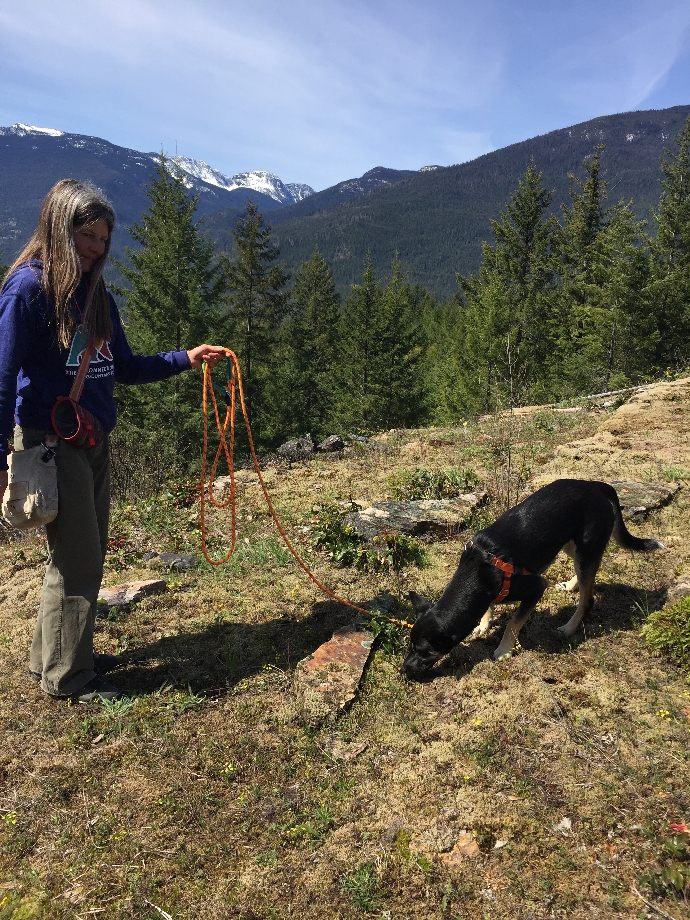
Grow your dog’s off-leash freedom using a long line - Part 1

Key Topics:
What is a long line
Why use a long line
How to use a long line
Be aware of your surroundings
When to avoid using a long line
What about puppies?
Introduction
When Marley was an adolescent and shortly after we moved to New Denver, we took him for an off-leash walk along the rail trail. Well, he saw a deer and with a joyous bark he was off chasing the deer into the distance. We kept walking and after what felt like an eternity but it was perhaps 5 minutes, he came back. Panting, happy, and fortunately un-injured.
While I enjoyed our off-leash time together, it wasn’t stress free for me because I was always worried about him leaving me to:
Chase deer or bear,
Run up to another dog/person team and follow them onto the highway (happened once),
Follow a great smell into the bush a not come back.
He was given 100% of the responsibility without any training and he made great dog choices but not the choices that would:
Make the walk safer for him,
Allow us to walk without the risk of chasing wildlife,
Make the walk more relaxing for me.
At the time, I didn’t know what to do, I wanted him to be off-leash but didn’t have the knowledge or the skills to train him to stay with me on our off-leash adventures.
Fast forward 16 years. What a difference. I now understand the why and how of training a dog to:
Value being close to me whether the leash is on or off,
Rehearse the behaviours I want,
Think the best party is about to happen when they hear their recall word.
So how can you teach a dog of any age including your adolescent dog (!) to:
Love hanging out with you,
Come away from distractions,
Make choices that will keep them safe and not annoy wildlife or the other people you encounter when out and about?
You can accomplish this with a long line.
What is a long line
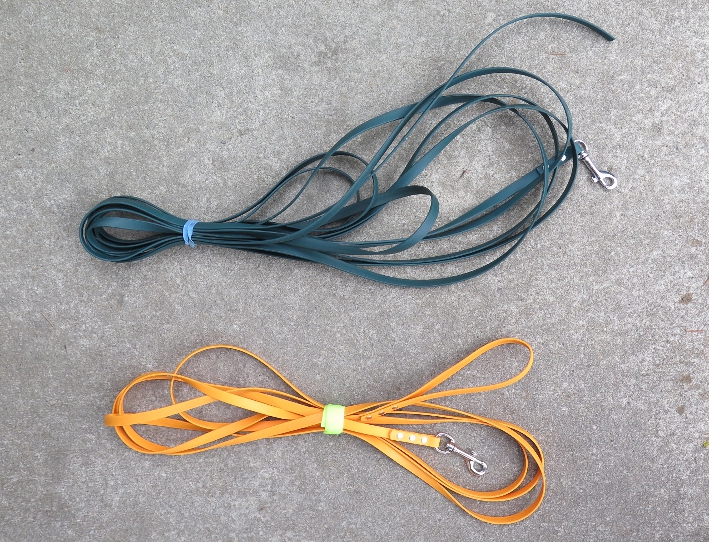
A long line is simply an extra-long leash with or without a handle. I like to use BioThane leashes for long lines because they are durable, waterproof, and easy to clean. They also come in different widths and a variety of colours.
The different widths allow you to select a leash suitable to your dog’s size with a thinner, lighter leash being more comfortable. The bright colours provide good visibility when the leash is dragging on the ground.
When you start working with a long line, the goal isn’t to restrain a strong, pulling dog but to:
Allow you to grow your dog’s freedom as their skills increase,
Give you a way to prevent rehearsal of behaviours you don’t want.
You will start with a 15’ long line with a handle. Your dog will have a bit more freedom while you continue to hold the leash.
As your dog’s skills improve, you can move up to a 30’ long line without a handle. No handle minimizes the risk of the leash getting caught on objects as it drags on the ground.
A leash longer than 30’ can be difficult to handle and isn’t necessary as the goal of the long line isn’t to allow your dog to disappear from sight while they drag a leash but to grow skills that will allow them to safely enjoy the outdoors with you when they are off-leash.
Why use a long line
Using a long line allows you to gradually give your dog more responsibility when outdoors without the risk that they will practice behaviour you don’t want.
A long line is a tool to help you train “for the situation” (off-leash freedom) before you put them “in the situation” (walking without a leash).
With a long line your dog has more freedom of movement, they can sniff and explore farther away from you, and they can be given more responsibility for making good choices which you can reinforce. At the same time, you can gather up the slack to limit their ability to make poor choices.
A long line is a tool to help you grow a dog who:
Values staying close to you,
Can disengage from wildlife, people, and dogs,
Will come when called.
At the same time, you can:
Grow your confidence and trust in your dog while keeping them from rehearsing the behaviour you don’t want
Grow your dog’s skill to prepare them for being off-leash rather than letting them off-leash and hoping for the best.
And because you need both hands to manage and work with a long line (at least initially!), it requires you to stay focused on your dog during your walks. When you are focused on your dog, you can play games, interact with your dog, and find opportunities to reinforce good behaviour!
How to use a long line
Before using a long line, you MUST condition your dog to wearing a harness. Attaching a long line to a collar is inviting a serious neck or throat injury.
The harness you choose should have a clip on the back. Clipping the leash onto a back clip harness can:
Keep the leash from being tangled in your dog’s legs,
Prevent injury to their neck if they run to the end of the leash at high speeds while you are holding the leash, if it suddenly gets stuck on something in the woods, or if someone steps on the leash.
There is no one right harness. You will need to find a harness that fits comfortably on your dog. When you attach a long line, the harness may rotate to the side causing the part between the front legs to chafe against the inside of the other leg. If you notice a significant change in your dog’s gait, you may want to try another harness (or perhaps a lighter leash) until you see their gait and comfort level improve. An unnatural gait could cause developmental problems in puppies and adolescent dogs.
You may want to wear gloves when working with a long line. Gloves will help to prevent rope burn if your dog suddenly moves away from you. Gloves will also keep your hands clean if the leash is dragged through mud, dirt, water, or poop!!
Once you have the right harness, and long line, you will need to learn the skill of gathering up and releasing the slack.
What you don’t want to do is wrap the line around your hand or fingers as this can be risky and cause serious injury if your dog decides to bolt. Instead, you need to become comfortable using a figure 8 motion to gather and hold the extra length.
Practice this skill in the house without your dog until you can do it effortlessly.
Once you are comfortable handling the leash, go for walk with your dog in a wide-open area away from traffic, dogs, and people. Large open fields at a local park or soccer field with no one using them are great spaces to practice.
Using your 15’ long line, can your dog walk without pulling you off your feet, can you gather up and release the slack without jerking your dog, can you keep the leash from getting tangled in your dog’s feet?
If yes, you and your dog are ready!
Be aware of your surroundings
Using a long line will give your dog more freedom and can make the walk more enjoyable for both of you but it’s also important to be aware of your surroundings for the safety of yourself, your dog, and others. Before going out on your long line adventure walk, keep the following in mind:
Know your local leash laws. Some may require that you use a 6’ leash.
Make sure you keep your dog close to you when going around corners or where there is low visibility so your dog isn't surprised with the sudden appearance of people or animals.
Keep your dog close when crossing a road or walking on a busy or congested street.
If you are out hiking, don’t risk tripping others with your long line. Gather up the slack and move to the side when passing others.
Trail manners still apply. If you are passing by other people or dogs on leash, shorten your long line so your dog doesn’t accidentally approach another dog without permission.
Don’t let your dog play with another dog on a long line. This can be dangerous as it’s easy for them to get tangled up and possibly tangled around you or other people.
When to avoid using a long line
Using a long line is a way for you to grow your dog’s off-leash freedom but you both need to have some skills before you head out or it will be frustrating for both of you.
A long line might not be the right tool at this time if:
Your dog is fearful, leash reactive, or aggressive. A long line can help dogs who struggle with these issues but you both will need foundation skills before heading out. You can book a free 30-minute Struggles to Strengths Discover Call to talk with me in more detail about how to skill up your dog.
Your dog rushes to the end of the leash on a regular basis. Grow your basic leash walking skills before you introduce a long line.
Your dog pulls you off your feet on a 6’ leash. More basic leash walking skills are needed before they are ready for this additional level of freedom.
Your dog is in the water. The long line could get stuck on something underwater which will trap your dog. This could be fatal if your dog is not wearing a life vest or they are in a fast-moving river.
You are constantly stepping on the long line to stop your dog from moving too far away from you. You both need to grow your skills! Bringing your dog up short like that on a regular basis is likely to be punishing to the dog and isn’t teaching them the skills needed to walk well on a long line.
What about puppies?
A long line is a great tool to allow your puppy the freedom to noodle around and safely explore the environment.
Your puppy should be wearing a harness
Use the lightest line possible to ensure your puppy is comfortable and their gait isn’t affected when the leash is dragging.
Conclusion
This post covered the what, why, how, and when of using a long line. They are an excellent tool to help grow your dog’s skills before you give them 100% of the off-leash responsibility. Using a long line and playing games to grow skills requires you to be an active participant in your adventure walks. The time you invest in growing the skills will pay dividends when you find yourself walking a dog who stays close, engages with you, and responds quickly when you give your recall cue.
Next month, we will talk about how you can set your dog up for success while you are growing their off-leash freedom skills.
Reference:
BC Wildlife Act Section 78: Dogs hunting game
Additional Resources:
Check out this post “BioThane Leashes and Long Lines - All About Sizing!” to give you a guideline on which BioThane leash width to select for your dog.
The following courses will help you grow off-leash freedom skills by using the power of games-based training! Get the dates and times from our Upcoming Classes web page.
Loose Leash Walking. Grow your dog’s loose leash walking skills using games to build value for proximity to you.
Off-Leash Freedom. Focus on growing your dog’s off-leash skills by building a solid recall cue, and learning how to gradually give your dog more responsibility when out and about.
90 Days to a Well-Behaved Dog. Shift from struggling to get your dog to listen to having a dog that happily responds the first time you ask even around distractions. Along with basic obedience, this course focuses on recall and loose leash walking.
